

Most articles about business central for manufacturing read like a feature list with the brochure photo still attached. This isn’t that.
This is for the operations manager who knows what their second-shift CNC was doing yesterday, because they walked over and looked. Whose Monday morning starts with last Friday’s production data, hand-keyed by a supervisor who’s now off the clock. Who’s been told for two years that real-time shop-floor visibility is “a maturity question” while their plant runs on three notebooks, two whiteboards, and a spreadsheet that hasn’t been reconciled with the ERP since Q2.
Here’s the working version. We’ll cover what Business Central actually does on a manufacturing floor, the five questions every ops manager asks before they recommend it, where it’s a fit, where it isn’t, and the specific path mid-size manufacturers are using to get to live data without a 14-month MES rip-and-replace.
WHO THIS IS FOR — Operations managers, plant managers, and IT leads at mid-size discrete or mixed-mode manufacturers (50–1,000 employees) who are evaluating Microsoft Dynamics 365 Business Central manufacturing, or who already run BC and want their floor data to show up there in real time.
1. Why this question keeps coming up in 2026
Five years ago, the question was “do we need an ERP at all?” Three years ago, it was “cloud or on-prem?” Today, the operations manager’s question is sharper and harder to answer with a brochure: how do we close the gap between what’s actually happening on the floor and what the ERP thinks is happening?
Three things changed at once.
Demand variability stopped being a once-a-year event
Mid-size manufacturers used to plan in quarters. Now they plan in weeks — sometimes in shifts. Customer mix changes faster, lead times have compressed, and the manual reconciliation that used to take a planning analyst eight hours on a Friday afternoon doesn’t fit in a week anymore. Static plans built on stale data fail more often, and they fail visibly to the customer.
Labour got expensive, and harder to find
If you can’t replace a retiring 25-year supervisor easily, you can’t keep running on tribal knowledge. The processes that used to live in a binder under someone’s desk have to live somewhere the new hire can find them. That “somewhere” usually ends up being the ERP.
The cost of bad data finally got measurable
Late month-end variance reports used to get filed. Now they get blamed. Finance has stopped accepting “we’ll catch it next quarter” as an answer. And every CFO has read the same article saying that 8–14% of labour-hour accuracy is lost between the floor and the GL when you capture hours on paper.
“I don’t have a data problem. I have a four-day delay between something happening on the floor and anyone in finance knowing about it. By the time we know, it’s too late to do anything except explain it.”
2. What business central manufacturing actually does (without the brochure language)
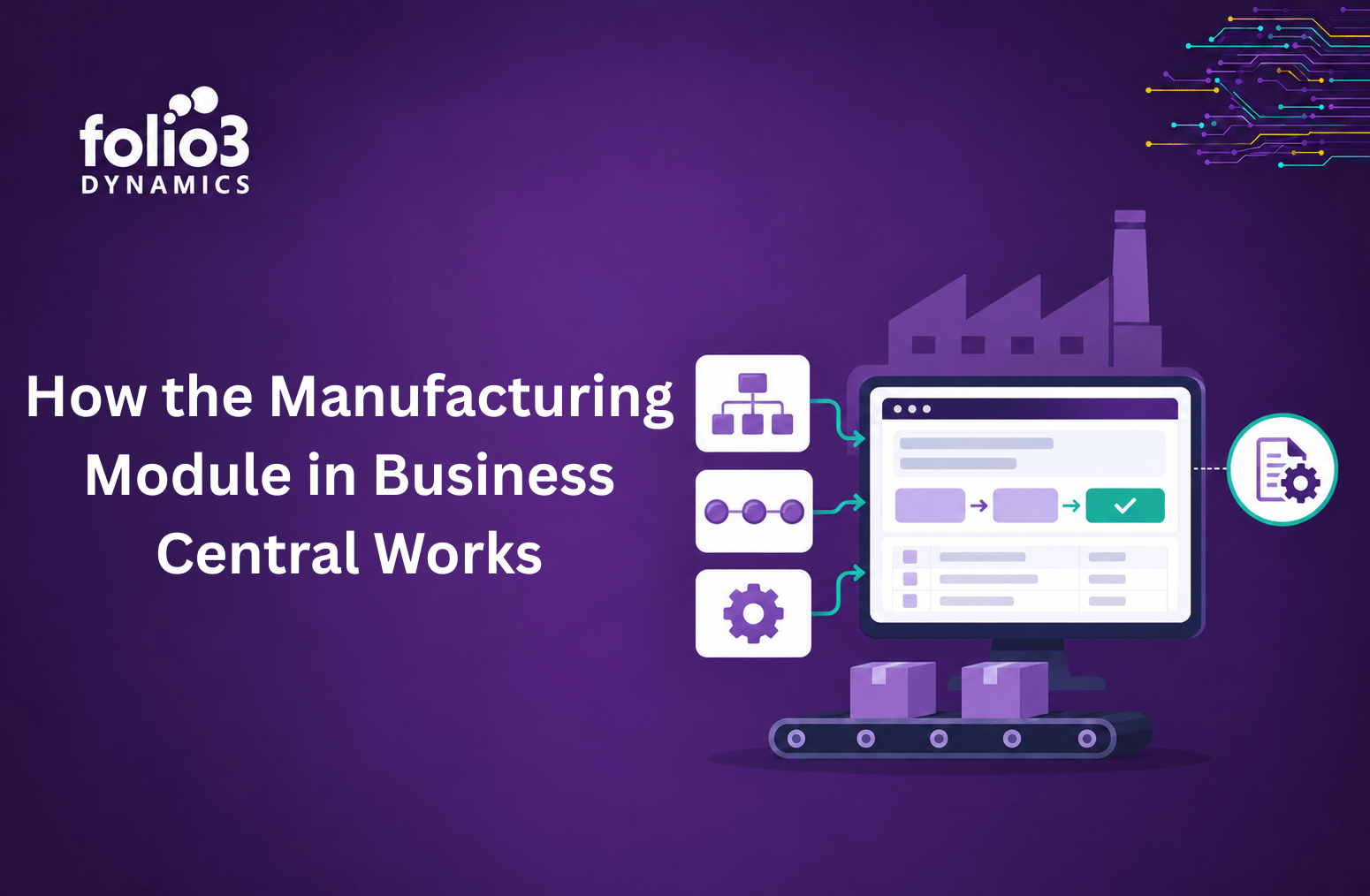
If you stripped the marketing site down to what an operations manager needs to know, dynamics 365 business central manufacturing covers four things:
- Master data: BOMs, routings, work centers, machine centers, items. The recipe and the process for everything you make.
- Production orders: the document that says “make 200 of this, here’s the path, here’s the materials, here are the hours.” This is where most of the operations work happens.
- Capacity & planning: MRP, the planning worksheet, finite vs infinite scheduling, demand forecasting. The bit that decides what gets made when, and whether you can promise a customer Tuesday or Friday.
- Costing: standard, actual, and variance costing, labour, material, overhead, flowing into the GL automatically. This is the bit finance cares about.
That’s the BC manufacturing module in one paragraph. What’s missing, and what every honest implementation partner will tell you, is the operator-facing data capture layer. Out of the box, BC assumes someone keys in the production journal. For mid-size manufacturers serious about real-time shop-floor visibility, that gap has to be closed with a shop floor data collection extension that posts directly to BC.
We’ve covered that pattern in detail on our shop floor data collection landing page, but for now, just know: the manufacturing module is the engine; the SFDC layer is what turns the keys.
3. The types of manufacturing in D365, and which one you actually run
This question gets asked a lot in vendor meetings and almost never answered honestly. Here’s the working answer.
Business Central handles five styles of manufacturing well. Whether it handles yours well is mostly a question of how much extension you’ll need and which licence tier you sit on.
| MANUFACTURING TYPE | HOW IT LOOKS IN BUSINESS CENTRAL |
|---|---|
| Make-to-stock (MTS) | Standard products, standard BOMs, and demand forecast drives production. BC handles this natively. The planning worksheet does the heavy lifting. This is the ‘easy’ case, most mid-size manufacturers running standard products land here. |
| Make-to-order (MTO) | Customer order triggers the production order. BC handles this natively too; the order management → production order link is built in. Works well for short to medium lead times. |
| Configure-to-order (CTO) | The customer chooses options from a catalogue, BOM gets configured per order. Native BC handles this with item attributes and assembly orders. For complex configurators (200+ options, dependency rules), most manufacturers add a CPQ tool that posts back to BC. |
| Engineer-to-order (ETO) | Custom design per order. BC handles this if you treat each order as a project, production orders linked to project tasks, and costs flowing to a job. Heavy ETO shops sometimes outgrow BC and move to F&O or specialised job-shop tools, but most mid-size custom equipment manufacturers stay on BC for years. |
| Process/batch | Recipes instead of BOMs, batches instead of discrete units, lot traceability across mixed yields. BC’s manufacturing module is fundamentally discrete, it works for light process (food, light chemicals) with extensions, but heavy process plants typically need a process-specific extension or move to F&O. |
Discrete vs process manufacturing in Business Central, the honest answer
BC’s manufacturing module was built for discrete and mixed-mode operations. It runs dynamics 365 discrete manufacturing well, that’s its native fit. It can be extended for light process manufacturing (and many mid-size food and beverage companies run on it successfully), but it isn’t a recipe-driven process MES. If your plant has batch genealogy requirements, regulated lot traceability beyond what BC ships with, or recipe-level enforcement at the workcenter, you’ll either need a specialised extension or you’ll be looking at F&O instead of BC.
If you’re in food, agribusiness, or process, our agriculture & food manufacturing solutions page covers the BC + extension stack we’ve deployed at process plants. The principle is the same , but the configuration is materially different from a discrete shop.
4. The four pain points that get manufacturers to evaluate BC in the first place
In the last three years of conversations with operations managers at mid-size manufacturers, four pain points come up in the discovery calls. If three or four of these sound familiar, you’re not behind, you’re in the median.
Production reports describe the past tense
Monday morning lands with last Friday’s data. You can’t change Friday on Monday. You can only explain it. Real time manufacturing data collection, capture happening at the workcenter, posting to BC the second it happens, is what closes that gap. The blocker isn’t usually BC; it’s the data capture layer between the operator and BC.
Three operators, three notebooks, three formats
Labour hours captured on paper, in spreadsheets, in a supervisor’s head. Job costs become job guesses. You can’t price what you can’t measure, and you can’t grow margin on numbers that arrive a week late. BC + a barcode/scanner SFDC layer makes this disappear, the act of doing the work becomes the act of recording it.
Customer service, finance, and operations have three different answers
Without a single live view of WIP, the four people who need the same answer get four different answers. The reconciliation work that runs through every Friday afternoon is symptom, not cause. The cause is that production data lives in one place, financial data in another, and customer service is reading neither.
Downtime found in the variance report
If a workcenter sat idle for six hours yesterday and you find out at month-end, you’ve already paid for it. Worse, the next shift might be repeating it. Manufacturing data collection systems that surface idle workcenters in real time save shifts, not just dollars. BC’s machine center tracking handles this if the data is flowing in. The whole game is whether the data is flowing in.
“We didn’t fix the floor by buying better software. We fixed it by making it impossible for an operator to do their job without the data being captured. The capture had to be invisible. Once that was true, everything else got easier.”
5. How Business Central handles production orders (the part that runs your floor)
If you only learn one part of business central manufacturing, learn the production order. It’s the document around which every other piece of the system rotates.
The lifecycle in five states
A production order in BC moves through five states:
- Simulated: What-if planning. Doesn’t consume material or capacity. Used for quoting.
- Planned: Generated by the planning worksheet from a forecast or sales order. Reservable.
- Firm Planned: Locked from MRP changes. The point at which planning hands off to scheduling.
- Released: Live on the floor. Material can be consumed, time posted, output reported.
- Finished: All output recorded, costs rolled up, inventory updated, GL hit.
Most floor activity happens against a Released order: operator clocks in, time posts, material backflushes, output gets reported, scrap codes get assigned. When the order changes to Finished, BC closes the loop, costs roll up, finished goods land in inventory, the GL gets the labour and overhead postings, and finance’s variance report has a row that didn’t have to be reconciled by hand.
Where most manufacturers stumble
Three places. First, master data, if your BOMs aren’t accurate at go-live, no production order will be either. Second, the data capture point, if the operator has to walk to a desk and type, half the events won’t get recorded. Third, costing setup, if standard costs aren’t maintained, the variance report will be either useless or panic-inducing.
6. SAP vs D365 for manufacturing, the honest comparison
This question gets asked in every evaluation and answered in zero of them. Here’s the version operations managers actually need.
SAP S/4HANA is genuinely excellent, for manufacturers above roughly $500M in revenue, with global operations, regulated industries, or complex multi-entity finance. SAP Business One sits at the other end, strong for small SMBs but limited on the manufacturing side. Dynamics 365 Business Central is targeted at the mid-market: roughly $25M to $500M, single-entity to mid-complexity multi-entity, light to mid-complexity manufacturing.
Here’s how the comparison actually shakes out for a mid-size manufacturer:
| FACTOR | SAP S/4HANA / SAP B1 | D365 BUSINESS CENTRAL |
|---|---|---|
| Implementation timeline | 9–18 months for S/4HANA. SAP B1 is faster but limited | 4–8 months is typical for BC manufacturing |
| License cost (per user, manufacturing user) | Higher per-user, separate manufacturing modules | Premium licence covers the manufacturing module fully |
| Microsoft 365 connection | Integrates, but not native, requires connectors | Native, Teams, Outlook, Excel, Power BI built in |
| AI / Copilot | Joule (S/4HANA), strong but separate licensing | Microsoft Copilot, native and included |
| Process/batch manufacturing | Strong, built for it | Discrete-first; light process possible with extensions |
| Mid-market fit | Often over-engineered for sub-$500M operations | Designed for $25M–$500M mid-size manufacturers |
| Total 5-year cost of ownership | Generally 2–3× BC for comparable scope | Lowest TCO in the mid-market |
The TL;DR: if you’re a $50M–$300M discrete or mixed-mode manufacturer, BC almost always wins on TCO, time-to-value, and ongoing change cost. If you’re a $500M+ regulated process manufacturer, SAP usually wins. The middle band, $300M–$500M, multi-site, mixed discrete/process, is where serious evaluation is warranted, and where most ops managers should pull in a partner who’s done both.
7. Can Business Central replace a dedicated manufacturing ERP (or an MES)?
This question gets ducked by every vendor article. Here’s the direct answer.
For most mid-size discrete and mixed-mode manufacturers, yes, with the right SFDC and quality extensions, BC covers the production execution scope that a separate MES would otherwise own. That’s labour and machine capture, dispatch, work instructions, quality events, scrap and rework, basic genealogy, and the planning-to-execution feedback loop.
For a few specific scenarios, no, keep a dedicated MES alongside BC:
- Pharmaceutical, biotech, or aerospace plants with regulated batch genealogy and electronic batch record requirements.
- Process plants with deep historian integration (OSIsoft PI, AspenTech) and recipe-level enforcement at the workcenter.
- High-mix, high-precision job shops with hundreds of routings per month, and where dispatch logic is more complex than BC’s planning worksheet can express.
- Multi-plant operations where one plant runs a heritage MES and ripping it out isn’t on the table this cycle, keep both, integrate cleanly.
For everyone else, and that’s the majority of mid-size manufacturers we work with, BC, plus the right SFDC extension, covers the scope. We’ve written a deeper comparison in our manufacturing ERP software overview if you want to go further on the BC vs dedicated MES question.
8. Business Central manufacturing costing, what actually changes when you turn it on
Every conversation about BC for manufacturing eventually hits costing. Here’s what changes when costing actually works:
Standard cost vs actual cost, set up once, used everywhere
BC supports both. Standard costing for predictable products and process manufacturing; actual costing for ETO and high-variance jobs. The choice has implications for MRP, planning accuracy, and finance close; make this decision early in implementation, not late.
Variance posts automatically to the right account on the right date
When a production order finishes, BC calculates labour variance (planned hours vs actual posted hours), material variance (planned consumption vs actual backflush), and overhead variance, and posts each to its own GL account in real time. The finance team’s quarter-end variance reconciliation goes from a four-day project to an oversight task.
Job-level profitability becomes visible
Once costing flows correctly, you can see margin by customer, by product line, by routing. Most manufacturers are surprised, usually unpleasantly, by the first three months of accurate data. That’s not BC’s fault; that’s the data finally being right.
We’ve documented the migration path from QuickBooks specifically on our QuickBooks to Business Central migration page, including how the costing setup works on day one.
9. What “real-time shop-floor visibility” actually looks like, once you have it
This is the working description ops managers should evaluate against. If a partner shows you a dashboard but can’t show you the data behind it being captured natively, you don’t have real-time visibility, you have a dashboard.
On the floor
Operators clock into a production order from a rugged terminal, scanner, or tablet. Three taps, six seconds. They report quantity completed, scrap, and any quality event from the same screen. Material backflushes automatically. The supervisor sees the run progress in real time on a Power BI screen mounted on the wall.
In operations
The plant manager opens a Teams card on their phone and sees current capacity utilisation, late jobs by workcenter, and any unplanned downtime in the last 30 minutes. Each of those data points came from the operator’s three taps, no separate system, no nightly batch.
In finance
Labour cost variance is current to the last clock-in. The CFO doesn’t see month-end surprises because there are no month-end surprises, the variance has been visible for three weeks.
In customer service
A customer calls asking about order PO-44129. The customer service representative opens Microsoft Dynamics 365 Business Central
and sees the latest production status synced directly from the shop floor, the order is currently in production at Workcenter 04 and remains on schedule for Friday delivery. No phone call to the floor. No searching through paper travelers. No waiting for a supervisor update. Customer service, operations, and finance are all working from the same live production data.
10. How mid-size manufacturers are actually getting there
If you take nothing else from this guide, take the path. The manufacturers who’ve made this transition successfully, without a 14-month consulting engagement, followed roughly the same five-step pattern.
Step 1: Audit your master data before you audit anything else
BOMs, routings, work centers, items. If they’re not accurate today, they won’t be accurate in BC tomorrow. This is the single most common reason BC manufacturing implementations stumble. Allocate two to four weeks. Treat it as a project, not a side task.
Step 2: Pick a single workcenter for the pilot
Don’t go floor-wide. Pick one workcenter: ideally one that’s high-volume, high-pain, and where the supervisor is technologically curious. Configure BC’s manufacturing module for that workcenter, deploy the SFDC capture layer, and run it for two to three weeks.
Step 3: Roll out workcenter by workcenter, not all at once
Each subsequent workcenter goes faster. By the third or fourth, you have a playbook. Don’t try to go live everywhere on the same day; the operators who learn second benefit from the operators who learned first.
Step 4: Connect to finance only after the floor is stable
Don’t let finance see the live cost data until the data is actually live and accurate. Premature exposure damages trust in the system. Wait until you have two clean weeks at the workcenter level.
Step 5: Add Copilot and Power BI dashboards last
These are the visible wins, but they only work on top of accurate data. Build the foundation first; the dashboards are easy once the data is right.
If you want a deeper view of how Folio3 runs this kind of staged rollout, the Folio3 Rapid Start methodology page walks through the implementation pattern in detail.
Conclusion:
Business Central for manufacturing isn’t magic. It’s a well-architected, mid-market ERP with a solid manufacturing module, a clean upgrade path to F&O, and a native connection to the rest of the Microsoft stack. What turns it into real-time shop-floor visibility, instead of a better data-entry destination, is the SFDC capture layer, configured by someone who knows what mid-size manufacturers actually look like. Most of the implementations that fail in this space fail because someone tried to do BC and SFDC sequentially. The ones that succeed treat them as one project.
READY TO STOP FEEDING THE ERP AND START FEEDING THE MACHINES?
Talk to a Folio3 D365 manufacturing specialist. 30 minutes. Your scenarios. No slide deck.
Not ready yet? See exactly how operations managers are running real-time shop floor data collection in Business Central, including the rollout pattern and the form to book a working session
Quick answers to the questions ops managers always ask
Is Microsoft Dynamics 365 good for manufacturing?
For mid-size discrete and mixed-mode manufacturers (50–1,000 employees), yes. The Microsoft Dynamics 365 Business Central manufacturing module covers production planning, BOMs, routings, work centers, costing, and capacity. With the right SFDC and quality extensions, it covers the production execution scope a dedicated MES would otherwise own. For very large enterprises ($500M+) or heavily regulated process plants, F&O or SAP S/4HANA is often the better fit.
Is Dynamics 365 good for discrete manufacturing?
Yes, discrete is BC’s home turf. The manufacturing module was built around discrete BOMs, routings, and production orders. Make-to-stock, make-to-order, configure-to-order, and engineer-to-order are all natively handled. Heavy ETO with hundreds of unique routings per month sometimes outgrows BC and moves to F&O, but most mid-size discrete shops stay on BC for years.
How does Business Central handle production orders?
Through a five-state lifecycle: Simulated → Planned → Firm Planned → Released → Finished. Most floor activity happens against a Released order, operators clock time, consume material, report output, and post scrap. When the order finishes, BC rolls up costs to the GL and updates inventory. With an SFDC extension, all of that capture happens at the workcenter in real time, instead of being keyed in by a supervisor at end-of-shift.
Can Business Central replace a standalone MES or SFDC tool?
For most mid-size manufacturers, yes, BC plus a native SFDC extension covers the production execution scope. For pharma, biotech, aerospace, and heavy process plants with regulated batch genealogy or recipe enforcement, keep a dedicated MES alongside BC. We give a straight answer to this question on assessment calls, partner-honest, not vendor-honest.
Which is better, SAP or D365 for manufacturing?
Depends on your size and complexity. For $25M–$500M mid-size discrete or mixed-mode manufacturers, BC is the better fit on TCO, time-to-value, and ongoing change cost. For $500M+ global, regulated, or heavy-process operations, SAP S/4HANA is usually better. The middle band ($300M–$500M, multi-site, mixed) is where serious evaluation is warranted.