

The Most Expensive Problems Begin Before the First Machine Runs
Ask any plant leader where their margin leaks, and most will point to the production floor — machine downtime, labor, scrap. But the costliest disruptions almost always begin upstream, in the part of the supply chain that rarely gets a dashboard: the delivery of materials.
The data backs this up. Global supply chain disruptions rose 38% in 2024 compared with the prior year, and manufacturing was among the five most disrupted industries for the fourth consecutive year. In the first half of 2024 alone, the manufacturing sector experienced 10,629 potential disruptions, a 30% jump year over year. Closer to the plant, the Federal Reserve Bank of New York found that 48% of manufacturers reported difficulty obtaining the supplies they needed in a single month, and nearly half had reduced output as a direct result.
For a CFO, that translates into working capital trapped in late or wrong inventory. For a CEO, it’s missed customer commitments and eroded trust. For an owner, it’s watching a profitable quarter quietly disappear because a single raw material arrived three days late or failed inspection after it was already on the line.
The encouraging part: this is the single most fixable stretch of the supply chain. “Analyzing the delivery of materials” means treating the beginning of your supply chain, from the purchase order process through inbound logistics to the goods receipt process, as one measurable, connected, and controllable system rather than a series of disconnected handoffs. When manufacturers do this inside a unified ERP like Microsoft Dynamics 365 Supply Chain Management, they stop reacting to material problems and start preventing them.
This guide walks through where the front of the supply chain breaks, the six strategic outcomes leaders should expect from fixing it, and the real-world use cases that make the business case obvious.
Six Cracks at the Front of the Supply Chain
Before solving anything, it helps to name precisely where the value escapes. These six problems show up in nearly every manufacturer still running the front of its supply chain on spreadsheets, email, and disconnected systems.
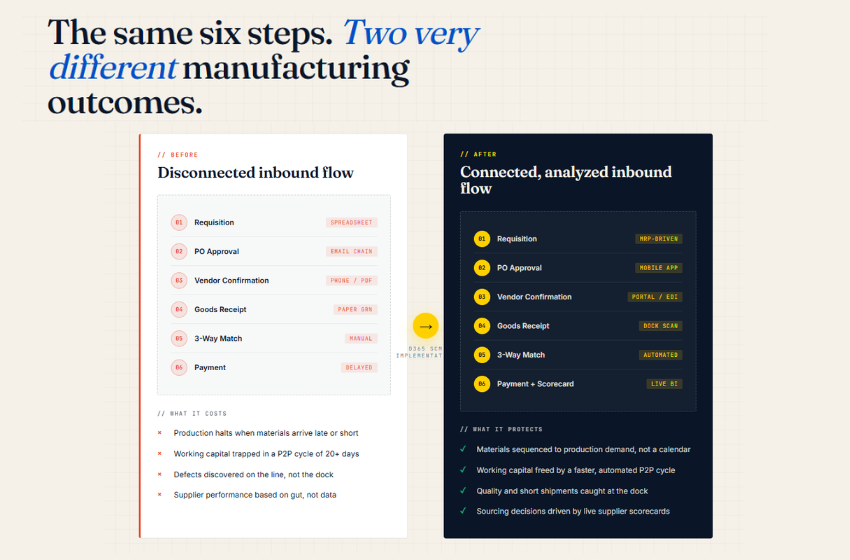
- A purchase order process that lives outside the ERP. When buyers raise POs in spreadsheets and chase approvals over email, the purchase order creation process and the purchase order approval process become invisible to production planning. Nobody can answer a simple question, “where is this order right now?”, without making three phone calls.
- No real-time inbound logistics visibility. Without connected systems, tracking inbound shipments, vendor confirmations, and expected delivery dates in real time is impossible. Planners learn about a delay when the truck doesn’t show up, far too late to resequence production. Understanding what inbound logistics actually covers, transportation, receiving, inspection, and putaway, is the first step to controlling it.
- A goods receipt process that records but never analyzes. Most teams log the goods receipt, print the goods receipt note, and file it. Few analyze goods issue vs goods receipt variance or enforce a raw material receiving checklist at the dock. The result: short shipments and quality defects are caught weeks later in reconciliation, or worse, on the production line.
- A slow, manual procure-to-pay cycle. Without procure-to-pay automation, the end-to-end procure-to-pay process drags across procurement, warehouse, AP, and finance with manual handoffs. Three-way matches fall out, invoices get parked, and the procure-to-pay cycle that should close in days stretches into weeks, locking up cash.
- Reactive supplier performance management. Without proper supplier performance management software or live scorecards, sourcing decisions rest on relationships rather than data. The same vendors who consistently miss SLAs keep winning the next contract because nobody is measuring them objectively.
- Supply chain risk hidden in the data. Manufacturers sit on enough information for meaningful supply chain analysis and supply chain risk analysis, lead-time variance, single-source exposure, raw material price drift, but it’s scattered across systems with no analytical layer to surface what’s about to break.
The common thread: these aren’t six separate problems. They are six symptoms of one root cause, a disconnected front-end. Fix the connection, and the symptoms resolve together.
Six Strategic Outcomes of Analyzing the Delivery of Materials
Rather than list features, here’s what leadership should actually expect to change when the beginning of the supply chain is connected and analyzed inside Dynamics 365. Each outcome maps to a capability your team can implement.
Materials That Follow Your Production Plan, Not a Calendar
When purchase requisitions and POs are driven directly from Master Planning (MRP) runs against your multi-level BOMs, inbound material flow is sequenced to real production demand. Planned purchase orders can be generated automatically from supply and demand forecasts. For the CFO, this means less cash tied up in materials sitting idle ahead of need, and fewer emergency expedite fees when something is short.
A Purchase Order Process With a Single Source of Truth
A structured purchase order creation process and a configurable purchase order approval process inside the ERP give every PO a clear owner, status, and SLA. Approvals route by amount, category, vendor, or plant, and managers can clear them from a phone via a mobile workflow approvals app without logging into the system. Buyers stop chasing signatures and start managing exceptions.
Quality Caught at the Dock, Not on the Line
Pairing the Dynamics 365 goods receipt process with a mobile warehouse management app lets your team scan goods at the dock, validate against the PO, run a raw material receiving checklist, capture lot data, and post the goods receipt note in one step. Defective or short material is rejected at receipt, before it becomes scrap, rework, or a customer complaint. For regulated manufacturers, lot traceability captured at receipt also makes recalls and audits a non-event.
A Procure-to-Pay Cycle Measured in Days, Not Weeks
When the end-to-end procure-to-pay process runs on connected workflows, requisition, PO, goods receipt, three-way match, payment, automation handles the routine and your team handles only genuine exceptions. Microsoft notes that automating the source-to-pay process reduces the time and effort required and cuts data-entry errors and duplicate payments. A faster procure-to-pay cycle frees working capital and unlocks early-payment discounts that manual cycles routinely miss.
Supplier Decisions Based on Data, Not Relationships
When every PO, receipt, and rejected lot updates the supplier record automatically, you get live vendor performance management, on-time delivery, fill rate, lead time, quality variance, without standing up separate vendor performance management software. Layering Power BI dashboards on top turns this into a living supplier scorecard, so procurement negotiates from facts and underperformers stop hiding in averages.
Early Warning on Supply Chain Risk
Connecting data across procurement, warehouse, production, and finance enables continuous supply chain analysis and supply chain risk analysis, flagging single-source dependencies, geographic concentration, and lead-time volatility before they stop a line.
| Outcome | What It Protects | Who Feels It Most |
| Materials follow the production plan | Working capital, uptime | CFO, Plant Manager |
| Single source of truth for POs | Speed, control | Procurement Lead |
| Quality caught at the dock | Scrap, rework, compliance | Quality, Operations |
| Faster procure-to-pay cycle | Cash flow, supplier terms | CFO |
| Data-driven supplier decisions | Margin, quality | Sourcing, CEO |
| Early warning on risk | Production continuity | CEO, Owner |
Use Cases: What This Looks Like in a Real Plant
Strategy is abstract until it touches a real workflow. Here are three scenarios that mirror how manufacturers actually feel the difference.
Discrete manufacturing (automotive components, electronics, machinery). A planner runs MRP against a multi-level BOM. The system generates planned POs tied to specific production orders, routes them through the purchase order approval process automatically, and sends confirmed orders to suppliers through the Vendor Collaboration portal. When components arrive, the warehouse team scans them against the PO at the dock. A short shipment is flagged instantly, and the planner resequences production the same morning instead of discovering the gap mid-shift.
Process and food & beverage manufacturing. Here, the raw material receiving checklist and lot capture are not optional. Incoming ingredients are inspected, weighed, and lot-tagged at receipt; certificates of analysis are attached to the goods receipt note; and full traceability flows downstream. If a recall is ever required, the manufacturer can trace a lot from supplier to finished good in minutes, not days, the difference between a contained event and a brand crisis.
Industrial and multi-plant operations. When a manufacturer runs several plants, inbound logistics data, goods issue vs goods receipt reconciliation, and supplier performance need to roll up into one view. Integrating Dynamics 365 with vendor portals, EDI partners, and carrier APIs through an integration platform like BURQ iPaaS means inbound data flows in without manual rekey, giving corporate one source of truth across every site.
Across all three, the pattern holds: the technology doesn’t just digitize the old process, it connects steps that used to be separate, so a problem at the dock instantly informs procurement, finance, and the production schedule.
Why Most “Procure-to-Pay” Projects Stall (and How to Avoid It)
Most content on this topic, and most competitors, lead with the same six-stage source-to-pay diagram and stop there. Microsoft itself frames the end-to-end source-to-pay process across requisition, PO, receipt, invoice, and payment. The diagram is correct, but a diagram has never fixed a plant.
In practice, procure-to-pay automation projects stall for three reasons:
- They automate a broken process. Pouring automation onto a flawed purchase order approval process just makes the mess move faster. The fix is a short diagnostic of the current procure-to-pay process flow before configuring anything.
- They sit outside the ERP. Bolt-on tools create reconciliation headaches between systems. Keeping the workflow native to Dynamics 365, extended with proven add-ons where needed, avoids the integration tax.
- They ignore the warehouse. A procure-to-pay project that doesn’t fix the goods receipt process leaves the most error-prone step untouched. The dock is where POs, quality, and invoices reconcile; it has to be part of the scope.
If a previous implementation already stalled on procurement or goods receipt, that situation is recoverable. A focused troubled-implementation rescue diagnoses what’s misconfigured in the purchase order process, goods receipt, and vendor master, then rebuilds the configuration around how the factory actually runs.
Conclusion
The beginning of the supply chain is where manufacturing margin is quietly won or lost. When the purchase order process, inbound logistics, the goods receipt process, and the full procure-to-pay cycle are connected and analyzed inside Microsoft Dynamics 365, tied directly to your BOMs and production schedule, material problems get caught early, cash moves faster, suppliers get measured honestly, and production stays running.
This is not a rip-and-replace transformation. For most manufacturers, it’s a focused effort to connect and instrument the front of the supply chain on the ERP foundation they likely already own.
If you’d like to see what full-chain inbound coverage could look like for your operation, across Dynamics 365 implementation, Finance & Operations, and manufacturing-specific solutions, contact us today to learn more. A short consultation with a Dynamics 365 manufacturing consultant will map your current purchase order process, goods receipt flow, and supplier performance setup, and show you where the highest-return improvements sit.
Frequently Asked Questions
What is inbound logistics in manufacturing, and how does Dynamics 365 support it?
Inbound logistics is the flow of raw materials and components from suppliers into your facility, including transportation, receiving, inspection, and putaway. In Dynamics 365 Supply Chain Management, it’s managed across the Procurement & Sourcing and Warehouse Management modules, with Master Planning (MRP) tying it back to your production schedule.
How does the goods receipt process work in Dynamics 365?
When a delivery arrives, your warehouse team scans incoming items against the purchase order, often using a mobile warehouse management app. The system validates quantities, runs the raw material receiving checklist, captures lot data, posts the goods receipt note, and triggers putaway, making the material available for production and AP matching.
What is the difference between goods issue and goods receipt?
A goods receipt records inventory coming in, typically raw materials received against a PO. A goods issue records inventory leaving, for example, raw materials issued to a production order or finished goods shipped to a customer. They are inverse transactions against the same item, and together they keep manufacturing inventory accurate.
What does the end-to-end procure-to-pay process flow look like in Dynamics 365?
Six stages: requisition → purchase order creation and approval → vendor confirmation → goods receipt → invoice and three-way match → payment. Microsoft documents this as the source-to-pay process, and each stage can be configured to your approval matrix and compliance requirements.
Can MRP be connected to the purchase order process for multi-level BOMs?
Yes. Dynamics 365 can drive purchase requisitions and POs directly from Master Planning runs against multi-level BOMs and production orders, standard scope in a manufacturing-focused implementation.
Do we need separate vendor performance management software?
For most manufacturers, no. Dynamics 365 tracks vendor performance natively, and it can be extended with Power BI scorecards for richer analysis. A specialized supplier performance management software is only needed for very complex supplier bases, and it can be integrated via an iPaaS platform.
Can the procure-to-pay process be automated if we’re already live on Dynamics 365?
Yes. Many manufacturers are already on Dynamics 365 but aren’t getting full value from procurement workflows. A review of the current procure-to-pay process identifies automation opportunities, then configures workflows and AP automation to compress the cycle. If a prior rollout fell short, a troubled-implementation rescue can recover it.
Which types of manufacturers benefit most from this?
Discrete (machinery, electronics, automotive), process (chemicals, coatings), food & beverage, pharmaceuticals, and industrial manufacturers all benefit, especially those with multi-level BOMs, batch processing, lot traceability requirements, or multi-plant operations.
Explore related topics on manufacturing ERP software, Dynamics 365 Finance & Operations, and Microsoft Dynamics 365 Copilot.