Partner with certified Business Central implementation partners to deliver a structured Microsoft Dynamics 365 Business Central implementation with controlled migration, integration-ready architecture, and adoption-focused rollout.
powered by



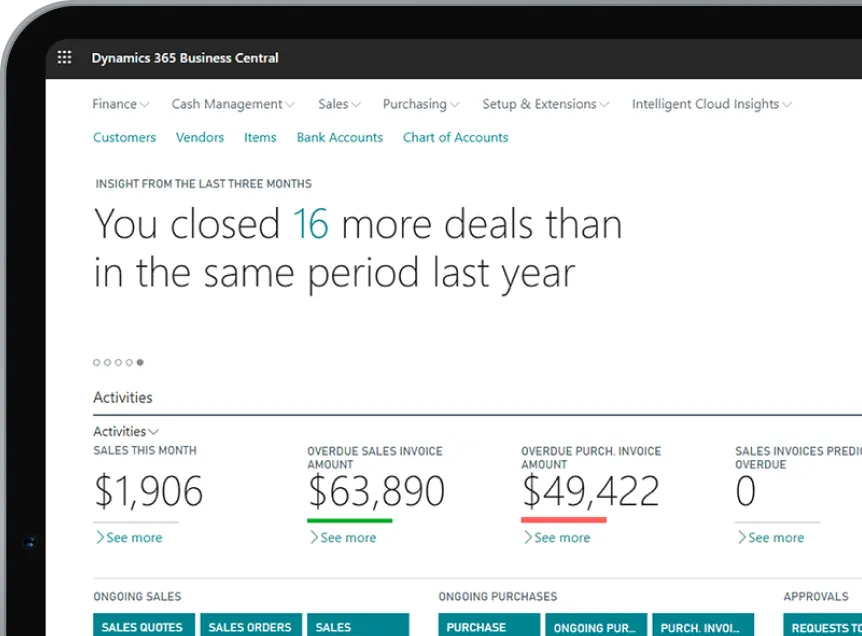
A Microsoft Dynamics 365 Business Central implementation is the structured setup and configuration of Business Central to match your organization’s finance, operations, sales, and supply chain processes. It turns the ERP from a standard product into a working system tailored to how your business actually runs.
A complete Microsoft Business Central implementation includes requirements mapping, module configuration, data migration, integrations, testing, training, and controlled go-live — so your teams can adopt the system quickly and start working with accurate, real-time data from day one.
Our Business Central implementation experts follow a structured delivery approach to ensure each deployment is aligned with real business workflows, reporting needs, and governance requirements — not just technical configuration.
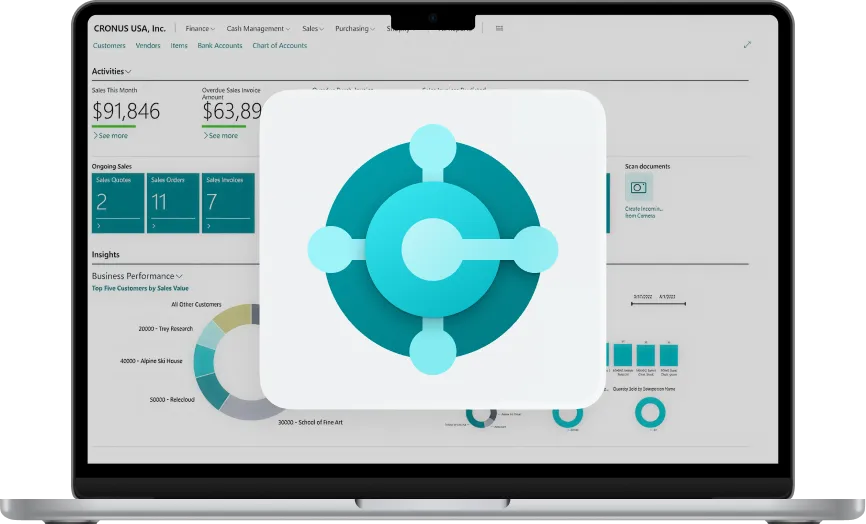
From setup through go-live and stabilization, we implement Business Central to reduce manual work, improve reporting accuracy, and give decision-makers reliable, real-time insight.
Standardize accounting, accelerate period close, and gain real-time financial visibility with a properly configured finance structure.
Connect purchasing, vendors, and inventory flows to improve planning accuracy and reduce stock disruptions.
Streamline quote-to-order and order-to-cash cycles with structured workflows and approval controls.
Enable bin, lot, and location tracking to improve fulfillment accuracy and stock transparency.
Replace disconnected spreadsheets with a single source of truth shared across departments.
Support production planning, consumption tracking, and operational costing with aligned system configuration.
Align project costing, billing, and revenue recognition with finance for tighter margin control.
Deliver role-based dashboards and live KPIs so leadership and managers see performance instantly.
Configure receivables, payables, and cash forecasting views for better liquidity planning.
Implement approval chains and control points to reduce risk and enforce governance.
Align Business Central with Microsoft 365, Power BI, and Power Platform for extended productivity.
Configure intercompany, consolidation, and currency handling for growing organizations.
Not every organization needs the same depth on day one. We offer two structured Dynamics 365 Business Central implementation services based on timeline, complexity, and transformation goals of your business.

Organizations that want fast deployment using standard Business Central best practices.
A fast, low-risk Business Central go-live with a scalable baseline you can expand later.

Organizations needing deeper process redesign and broader system
coverage.
A Business Central platform aligned to your operating model, reporting needs, and long-term scale.
Regardless of which implementation option you choose, every Dynamics 365 Business Central implementation follows a structured phase-based delivery model to ensure predictability and quality.

Join the ranks of satisfied customers who have partnered with Folio3 and experienced the transformative power of Dynamics 365 Business Central. Here are some of our trusted partners:
Partner with Folio3’s certified team for a structured Dynamics 365 Business Central implementation with controlled rollout and measurable outcomes.
Implementation timelines depend on scope and complexity. Rapid implementations for standard finance and operations typically take 1–3 months, while transformation-led implementations with multi-entity setups or heavy integrations usually run 3–6 months or longer.
Rapid Implementation (1–3 months) focuses on fast deployment using standard best practices with core modules and minimal customization. Digital Transformation Implementation (3–6+ months) involves deeper process redesign, multi-module rollout, advanced integrations, and custom workflows aligned to your operating model.
Business Central implementation costs depend on scope, not a fixed price. A rapid, standard deployment costs significantly less than a multi-entity transformation engagement. Key cost drivers include number of modules, required integrations, data migration complexity, customization needs, and user count. We scope each engagement based on your actual requirements and provide a fixed-fee proposal so there are no surprises.
While Business Central can technically be self-implemented, most organizations work with a certified Microsoft partner to reduce risk and accelerate time to value. A partner brings pre-built implementation methodology, configuration expertise, data migration experience, and post-go-live support — all of which are difficult to replicate without prior Business Central deployments.
Yes. We provide validated, reconciled data migration from legacy ERPs and accounting systems, including master data, open transactions, historical balances, and controlled cutover planning to ensure accuracy and audit confidence.
Absolutely. We design and implement integrations with Microsoft tools like Power BI, Power Platform, and Dynamics CRM, as well as third-party systems such as payroll, eCommerce, banking, EDI, and industry-specific applications.
Yes. Phased implementations are often the best approach for complex organizations or multi-company environments, allowing you to roll out modules, entities, or regions in stages to reduce risk and disruption.
We deliver role-based end-user training as well as administrator and super-user training, tailored to your processes and including documentation, walkthroughs, and knowledge transfer to ensure long-term self-sufficiency.
Post go-live, we provide hypercare support to stabilize operations, resolve issues quickly, and support users. We also help plan optimization and enhancement phases to ensure you continue getting value from Business Central as your business evolves.
Every implementation follows a structured delivery model including Discovery & Planning, Solution Design, Configuration & Build, Data Migration, Testing & Validation, Go-Live & Stabilization, and Optimization to ensure predictability and quality.