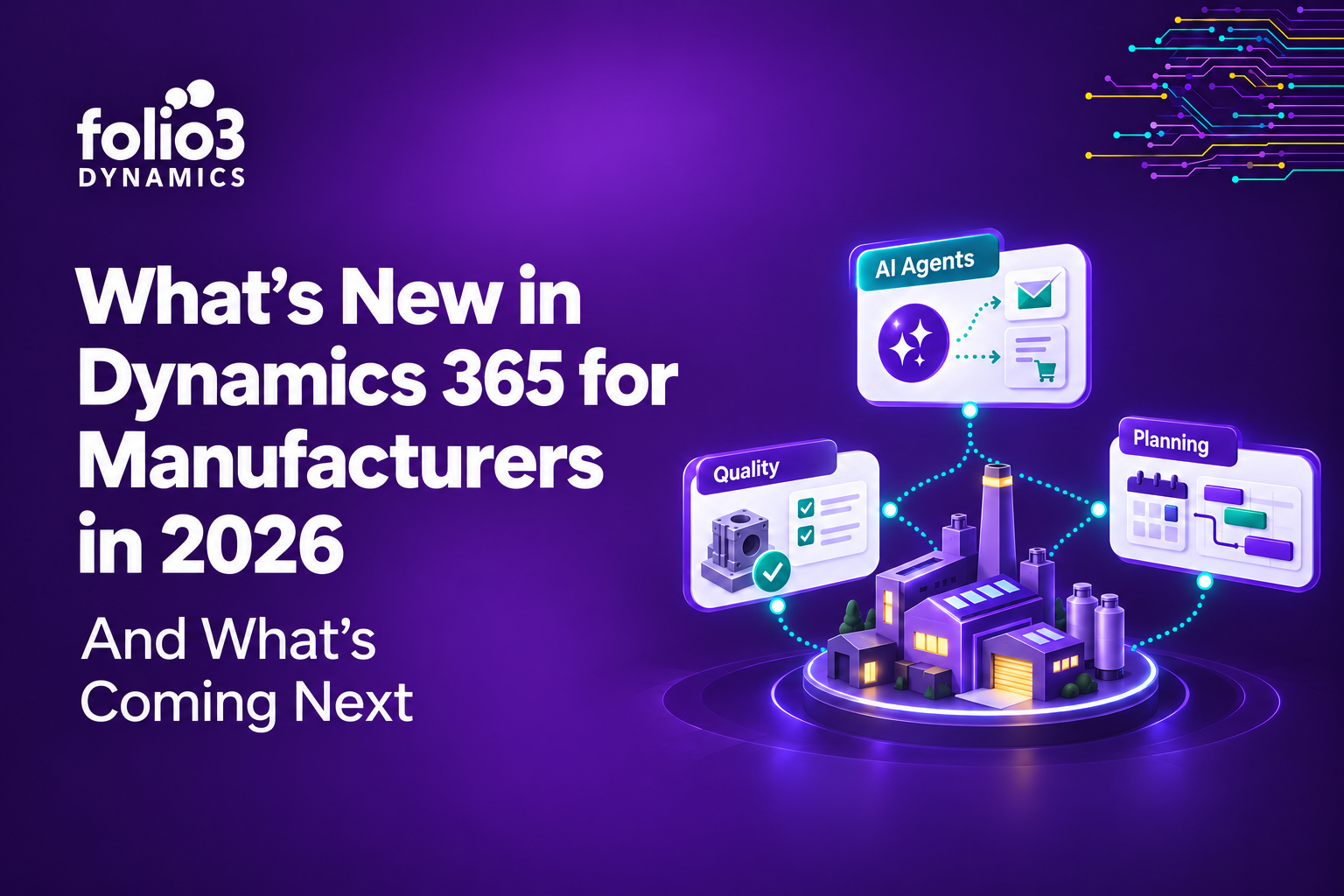


In 2026, Microsoft Dynamics 365 gave manufacturers native quality management and subcontracting in Business Central. Supply Chain Management gained more reliable promise dates and AI-assisted demand planning. In addition, new AI agents now act on customer, supplier and invoice emails. This guide lists each change with its date and status, plus what’s coming next.
Key Takeaways
- Business Central now does quality and subcontracting natively. Quality Management reached general availability on April 1, 2026, and native subcontracting on July 8, 2026.
- Supply Chain Management planning got more reliable. Planning Optimization can now protect confirmed capable-to-promise dates (in preview, with general availability planned for September). Demand planning added AI insights and external signals in August.
- AI agents moved from pilot to production. Business Central’s Sales Order and Payables agents are production-ready. The Supply Chain Management Procurement Agent, which traces supplier changes through to production orders, is in public preview.
- Microsoft changed how it ships. Release plans were retired in September 2026 in favor of a continuous roadmap, and Business Central 29 is due in early October.
- Legacy customers have a deadline and an incentive. Dynamics GP support ends December 31, 2029, and Microsoft’s Bridge to Cloud 3 promotion offers 30% off cloud licenses through 2027.
Why 2026 Matters for Dynamics 365 Manufacturers
2026 is the year Dynamics 365 manufacturing moved from add-ons to built-in features, and from Copilot to agents. For example, Business Central picked up capabilities that manufacturers used to buy from ISVs. Similarly, Supply Chain Management tightened the link between the plan and the promise date. In addition, Microsoft shipped agents across both products that read supplier and customer emails and act on them.
The timing matters. In the second quarter of 2026, 83.1% of US manufacturers named rising raw material costs as their top challenge and 71.8% cited trade uncertainty, according to the NAM Q2 2026 Manufacturers’ Outlook Survey. When input costs and supplier dates change weekly, the features in this update are the ones that reduce firefighting.
This guide lists every 2026 change that matters to manufacturers, with dates and status. It is organized by product, then covers the agent platform, licensing and lifecycle changes, and what to do next. Each feature is marked as available (released for production use), in preview (open for testing, not yet supported in production) or planned (announced, not yet released). That difference decides whether you can rely on it today.
What Are the Biggest Dynamics 365 Changes for Manufacturers in 2026?
These are the ten changes with the biggest impact on manufacturing operations, newest first. Status is as of September 28, 2026.
| Change | Product | Status | Key date |
|---|---|---|---|
| ERP MCP server and Copilot Cowork plugin | Finance and SCM | Available | Sep 23, 2026 |
| Protect confirmed capable-to-promise (CTP) dates | SCM | In preview | Release planned Sep 2026 |
| Same-batch enforcement for raw materials | SCM | In preview | Release planned Sep 2026 |
| Generative demand insights with external signals | SCM | Available | Aug 2026 |
| Native subcontracting | Business Central | Available | Jul 8, 2026 |
| Multiple Sales Order Agents per company | Business Central | Available | Jul 8, 2026 |
| Serial and batch capture in cluster picking, plus wrist-mounted scanners | SCM | Available | Jun 5, 2026 |
| Procurement Agent impact analysis | SCM | In preview | Preview since Apr 24, 2026 |
| Native Quality Management | Business Central | Available | Apr 1, 2026 |
| Location-specific WIP posting and serial-level output | Business Central | Available | Apr 1, 2026 |
Sources: Microsoft’s Business Central and Supply Chain Management 2026 release wave 1 plans, and Microsoft’s September 2026 ERP announcement.
What’s New in Dynamics 365 Business Central for Manufacturers in 2026?
Business Central had its most significant manufacturing year in some time. Two capabilities that small and mid-sized manufacturers used to buy as add-ons are now built in, and several long-standing costing annoyances were fixed.
Native quality management
Business Central now includes a Microsoft-published Quality Management app. It creates inspections at key points in purchasing, production, assembly and warehouse processes. It uses templates with measurements and pass/fail criteria, can block noncompliant lots automatically, and can trigger workflows from inspection results. It went into preview on November 16, 2025 and became generally available on April 1, 2026.
In fact, Microsoft built the app on a licensed subset of Insight Works’ Quality Inspector, a long-established Business Central add-on. If you pay for a third-party inspection extension today, compare it against the native app before your next renewal.
Native subcontracting
Subcontracting is now a native production capability, generally available since July 8. Business Central can ship components to a subcontractor as part of the production workflow, with inventory movement, warehouse handling and lot and serial tracking maintained throughout. The Manufacturing Power BI app also gained subcontracting analysis on April 1.
Fixes that matter to cost accountants
Three smaller manufacturing usability changes, released on April 1, 2026, remove real friction:
- Location-specific WIP. Capacity and overhead now post using the production location’s inventory posting setup. Previously they all went to a blank-location WIP account, which unbalanced sites that post material by location.
- Serial-level output. When you explode routing in the output journal for serial-tracked items, the last operation now splits into one line per serial number.
- Quieter BOM warnings. Each user can turn off the repeated warning about non-certified production BOMs and routings.
Other April updates help too. Requisition worksheets and item journals can now go through approval workflows. You can choose planning behavior for items without SKUs at a location. Item variants can carry pictures and attributes, which helps with configured products.
Agents for order-to-cash and procure-to-pay
The Sales Order Agent and Payables Agent both became generally available in November 2025 and kept improving through 2026. Since July 8, a company can run several Sales Order Agents with smarter item matching, for example one per sales team or channel. Payables Agent processing got faster in August with Known Senders. Agent Designer, for building your own agents, has been in preview since February 6, 2026, with general availability planned for October 2026.
Coming in Business Central 29 (expected early October 2026)
The public preview of version 29 lists several manufacturing improvements:
- Create released production orders directly from the planning worksheet.
- Monitor and update capacity calendars.
- Carry routing comments and attachments into subcontracting purchase orders.
- Use basic warehouse picks and put-aways for subcontracting.
- Finishing a quality inspection now fills in passed and failed quantities automatically.
For a deeper look at Business Central on the plant floor, see our guides to Business Central for discrete manufacturing and shop-floor data collection.
Case in point. Folio3 helped All Together Enterprises, a cloth diaper manufacturer in Sandy, Utah, move its operations onto Business Central with variant-level BOMs and integrated Shopify, Amazon and 3PL workflows. The result: 80% less manual reconciliation and more than 40% faster warehouse processing.
Not sure which of these Business Central updates to switch on? Talk to our Business Central team about what fits your plant.
What’s New in Dynamics 365 Supply Chain Management for Manufacturers in 2026?
In Supply Chain Management (SCM), the 2026 changes focus on making the plan more trustworthy, forecasts more explainable and supplier disruptions faster to absorb.
Planning: promise dates that stick
Planning Optimization is now the master planning engine for SCM. In fact, from version 10.0.41, the older engine is blocked for all new deployments. In 2026 it gained a feature that planners and customer service teams have wanted for years.
Protect confirmed CTP dates. Planning Optimization can now protect the material and capacity allocated to sales order lines whose delivery dates were confirmed through capable-to-promise. Newer orders can no longer quietly take those resources during replanning. It entered public preview on June 1, 2026, with general availability planned for September.
Manufacturers with plants in China can also run Planning Optimization on Azure operated by 21Vianet, generally available since June 9, 2026.
Demand planning: forecasts you can explain
- Generative insights and external signals (available since August 2026). Demand planning now surfaces seasonality, trends and signal correlations, and can factor in external data such as inflation, pricing and weather.
- Price-demand correlation. New capabilities identify how sales price changes affect demand, so pricing and demand plans can be built together.
- AI explanations of forecast accuracy. In preview since July 31, with general availability planned for October 2026.
Earlier in the cycle, the 2025 release wave 2 (October 2025 to March 2026) added event and promotion planning to demand planning. Austrian pipe maker Poloplast uses demand planning to push item-level forecasts straight into master planning, and says the forecasting engine usually outperforms manual predictions.
Process manufacturing: same-batch enforcement
SCM can now enforce same-batch selection for raw materials on production and batch orders. This is especially important for food, chemicals and pharmaceuticals, where mixing batches breaks consistency or traceability. It entered preview on July 27, 2026, with general availability planned for September. The same wave 2 update that added promotion planning also added sample management to quality management.
Procurement: from supplier email to production impact
A supplier’s delay email is really a production risk. The Procurement Agent, announced in public preview at Hannover Messe in April 2026, decodes supplier communications. It then identifies which production orders, inventory positions and customer commitments are at risk. Its impact analysis, in preview since April 24, traces supplier-proposed PO changes to affected sales, production and transfer orders and projected inventory.
Supplier Engagement entered public preview on July 27, 2026, with general availability planned for March 2027. It brings onboarding, requests for quotation, purchase orders and invoicing into one workspace and supplier portal across legal entities. The Supplier Communication Agent also gained support for Excel attachments this year.
For how inbound material problems ripple through a plant, see Analyzing Delivery of Materials.
Warehouse: capture traceability while picking
Three warehouse updates reached general availability on June 5, 2026:
- Precise serial and batch capture during cluster picking.
- Support for wrist-mounted scanners for hands-free picking.
- Advance shipping notices (ASNs) for receiving transfer orders.
Dynamic item placement, which gives more control over where inventory is stored, is in preview with general availability planned for October.
How Are AI agents Changing Dynamics 365 for Manufacturers?
The biggest structural change in 2026 is not one feature. Instead, it is the plumbing that lets AI agents safely read and act on ERP data.
- ERP MCP server and Copilot Cowork plugin (available since September 2026). Both let agents reason over and work with ERP data, actions and attachments. Copilot responses also include citations and deep links back to the underlying records. Business Central’s own MCP server has been generally available since April 1 and gained access to more data on June 12.
- Tighter agent permissions. Microsoft says new role-based controls will let organizations restrict what users can do when they act through Copilot Cowork or agents.
- Manufacturing partner agents. At Hannover Messe, partners showed agents built on the same foundation: Cegeka’s Quality Impact Recall Agent for batch- and serial-controlled products, Staedean’s engineering change impact agent, and Experlogix’s configure-price-quote agent.
- Field Service for equipment uptime. The Scheduling Operations Agent, in public preview, helps dispatchers optimize technician schedules against defined objectives and review proposed changes before applying them.
A note on preview features and cost
Many of the most-discussed agents are still in public preview, including the SCM Procurement Agent and the Field Service Scheduling Operations Agent. Preview features are not meant for production use and can change before release. Pilot them on a narrow process, such as one supplier group, before depending on them.
Agents also consume Copilot Credits. Supply Chain Management Premium includes 1,000 credits per user per month, and additional credits are available pay-as-you-go. Estimate volume before scaling any agent across the business.
For what Copilot can do across Dynamics 365 today, see our Copilot for Dynamics 365 page.
What Dynamics 365 Licensing and Support Changes Affect Manufacturers in 2026?
Several 2026 changes affect cost and timing more than features. Manufacturers on legacy Dynamics products should therefore pay particular attention.
Legacy Dynamics deadlines
| Product | What happens | Date |
|---|---|---|
| Dynamics NAV 2016 | Extended support ended; no more security updates | Apr 14, 2026 |
| Dynamics NAV 2017 | Extended support ends | Jan 11, 2027 |
| Dynamics NAV 2018 (final version) | Extended support ends | Jan 2028 |
| Dynamics GP | Technical support ends; security updates continue to Apr 30, 2031 | Dec 31, 2029 |
| Dynamics NAV and GP | Service plans end; no more licenses; product availability ends | Apr 30, 2031 |
Microsoft confirmed the April 30, 2031 NAV changes on July 28, 2026. After that date, customers can no longer renew Enhancement or Advantage plans or buy additional NAV users. The NAV 2016 date comes from Microsoft’s lifecycle page, GP dates from Microsoft Learn, and the NAV 2017 date from Lansweeper’s lifecycle tracker.
Incentives and tools for moving to the cloud
- Bridge to Cloud 3 (BTC3). Microsoft’s BTC3 promotion runs from January 1, 2026 to December 31, 2027. During that window, it offers eligible NAV, GP, AX and SL customers 30% off Dynamics 365 cloud licenses for a three-year term. Eligibility requires a perpetual license bought before September 1, 2024 and an active Enhancement Plan. Ask us whether you qualify, since terms apply per agreement.
- Easier data migration. Since April 1, Business Central can migrate to the cloud from any SQL database. A tool for running reimplementation projects through the cloud migration tool entered preview on June 30.
- Dynamics 365 Activate. Launched on September 9, 2026, this AI-powered migration tool starts with Salesforce-to-Dynamics 365 moves. Microsoft says ERP scenarios are planned but not yet available.
Pricing and roadmap
- Business Central prices rose on November 1, 2025, the first increase in more than five years. Essentials went to $80 and Premium to $110 per user per month, with more storage included; manufacturing requires Premium. For a full cost comparison, see our manufacturing ERP buyer’s guide.
- Release waves are gone. From September 2026, Microsoft publishes new Dynamics 365 capabilities to the always-on AI at Work roadmap instead of twice-yearly release plans. Business Central version numbers continue, but features now arrive continuously.
Still on NAV, GP or AX? Talk to our migration team about BTC3 eligibility and a realistic timeline, or see how we run Dynamics 365 migrations.
What Should Manufacturers on Dynamics 365 Do Now?
Most manufacturers should do three things before the end of 2026. First, switch on the features that are already released. Next, test what is coming in a sandbox before it reaches production. Finally, set a firm date for leaving any Dynamics product that is losing support. What that looks like depends on your starting point, so the checklist below is split by the system you run today.
If you run Business Central
- Turn on Quality Management and compare it with your ISV. New environments install it automatically; existing ones can add it from Extension Management. List which inspection points you use today and check whether the native app covers them.
- Move subcontracting onto the native framework. Test it with a real outside operation, including lot or serial tracking and the warehouse flow.
- Check your WIP accounts. If you post by location, confirm capacity and overhead now land in the right site’s WIP account after the April 1 change.
- Test version 29 now. Create a sandbox on the 29.0 preview and run your planning-worksheet and subcontracting scenarios. Microsoft deletes preview sandboxes 30 days after general availability, in early November 2026.
- Pilot one agent. For example, the Sales Order Agent is a good first candidate if customers email orders.
If you run Supply Chain Management
- Confirm you’re on Planning Optimization. The old engine gets no new features, and every 2026 planning improvement lands only in Planning Optimization.
- Plan to enable CTP protection once it reaches general availability. Before then, agree internally which orders count as “confirmed”.
- Pilot the Procurement Agent on one supplier group. Measure time saved and accuracy before expanding, and budget for Copilot Credits.
- Process manufacturers: evaluate same-batch enforcement against your quality and traceability procedures.
If you’re on NAV, GP or AX
- Check BTC3 eligibility before December 31, 2027.
- Work back from the deadlines. A migration covers assessment, data migration, configuration, testing and training, so start well before your support date. Most manufacturers also need time to clean up BOMs, routings and item tracking.
- Decide between Business Central and Supply Chain Management before scoping the project. Our buyer’s guide covers the decision.
What’s Coming Next in Dynamics 365 for Manufacturers (October 2026 to March 2027)?
These items are announced or planned but not yet generally available. Dates can move; check the AI at Work roadmap before planning around them.
| Expected | Product | What’s coming |
|---|---|---|
| Early Oct 2026 | Business Central 29 | Released orders from the planning worksheet, capacity calendars, subcontracting enhancements, quality inspection automation |
| Sep–Oct 2026 | SCM | Release of CTP date protection and same-batch raw material enforcement (planned Sep); forecast-accuracy AI explanations and dynamic item placement (planned Oct) |
| Oct 2026 – Mar 2027 | SCM and Finance | Rental management preview; Microsoft-provided business skills for agent-driven procure-to-pay; recurring schedule optimizations in Field Service |
| Mar 2027 | SCM | Supplier Engagement workspace and supplier portal become generally available |
| Jan 11, 2027 | NAV 2017 | End of extended support |
| Late 2026 | Gartner | 2026 Magic Quadrant for Cloud ERP for Product-Centric Enterprises (Microsoft was named a Leader in 2023, 2024 and 2025) |
Sources: BC 29 preview, SCM release plan, Microsoft ERP update, Microsoft on Gartner 2025.
We’ll update this guide as these items ship.
Ready to Put the 2026 Updates to Work?
However, new features only pay off once they are configured, tested and adopted on the floor. Folio3 Dynamics implements Business Central and Supply Chain Management for discrete, process and mixed-mode manufacturers, and handles migrations from NAV, GP and AX. We can review your environment, identify which 2026 capabilities are worth turning on, and plan a low-risk rollout.
Talk to a Dynamics 365 Expert or explore our Dynamics 365 for manufacturing services.
Frequently Asked Questions
Does Business Central have quality management now?
Yes. Quality Management became generally available in Business Central on April 1, 2026, as part of the 2026 release wave 1 (version 28). It creates inspections for purchasing, production, assembly and warehouse processes, supports pass/fail templates and can automatically block noncompliant lots.
When will Business Central 29 be released?
Microsoft expects version 29.0 to become generally available in the first week of October 2026. Its public preview ran from early September.
What AI agents are available for manufacturers in Dynamics 365?
In Business Central, the Sales Order and Payables agents are production-ready. The Expense Agent is in preview, and so is Agent Designer, which lets you build your own agents; its general availability is planned for October 2026. In Supply Chain Management, the Procurement Agent, which triages supplier changes and analyzes their impact on production, is in public preview. Partners also offer manufacturing agents for recalls, engineering changes and CPQ, built on the generally available ERP MCP server.
What replaced Dynamics 365 release waves?
From September 2026, Microsoft publishes new Dynamics 365, Power Platform and Dataverse capabilities to the always-on AI at Work roadmap instead of twice-yearly release plans. However, existing release plans remain available for reference.
Is there a discount for manufacturers moving from Dynamics NAV or GP to Dynamics 365?
Yes. Microsoft’s Bridge to Cloud 3 promotion runs from January 1, 2026 to December 31, 2027. It offers eligible NAV, GP, AX and SL customers 30% off Dynamics 365 cloud licenses for a three-year term. Eligibility depends on when the perpetual license was bought and on having an active Enhancement Plan.
Does manufacturing in Business Central require a Premium license?
Yes. Manufacturing in Business Central, including production orders, production BOMs, routings and MRP, is part of the Premium experience. Premium costs $110 per user per month since November 1, 2025; Essentials, at $80, does not include manufacturing.
Is Planning Optimization required in Dynamics 365 Supply Chain Management?
For new deployments, yes. From version 10.0.41 the deprecated master planning engine is blocked, so Planning Optimization is the standard engine. Existing customers still on the old engine should plan to move, because new planning features such as protected CTP dates are built for Planning Optimization.
Last updated September 28, 2026. Feature status and dates come from Microsoft’s release plans, Microsoft Learn and the Microsoft Dynamics 365 blog, and may change. Preview features are not intended for production use.