

Real-Time Supply Chain Monitoring: The 5 Things Every Manufacturer Must Watch (and Why End-of-Day Reports Keep Losing You Money)
Ask your CFO when they spotted the last cost overrun on a production job. Ask your COO when they found out a key supplier was running three weeks late. The answer is almost always the same. Too late to do anything about it.
That gap, between the moment something goes wrong on your shop floor and the moment leadership sees it, is where margin quietly disappears. It is also where customer trust is lost, suppliers get away with under-delivering, and operations teams burn out chasing fires that should have been caught hours, not days, earlier.
The numbers behind this are not subtle. According to McKinsey’s 2024 Global Supply Chain Leader Survey, 90% of companies faced supply chain disruptions last year, and most still understand their supply chain risk only as far as their tier-one vendors. Gartner puts a sharper point on it: just 7% of supply chain leaders say they have the infrastructure to respond instantly to disruptions. The other 93% are reacting to yesterday’s data.
For mid-market manufacturers running Microsoft Dynamics 365 Business Central, that gap is closable. Not with a rip-and-replace project. Not with another bolt-on dashboard tool. With a focused decision about what you choose to monitor in real-time, and how you set up the ERP you already own to surface it.
This is a guide to the five things every manufacturer should monitor live, why each one matters to the people running the business, and how a properly configured rollout turns Business Central into the real-time supply chain visibility software your whole plant runs on.
Why “We Have Reports” Is No Longer an Answer
Walk into most manufacturing operations and you will find the same setup. An ERP, a few spreadsheets, a couple of legacy systems no one quite trusts, a daily standup, and a weekly report deck that everyone reads on Monday morning.
That model worked when supply chains were slower and disruptions were rarer. It does not work now.
Here is what is actually happening underneath that “we have reports” answer:
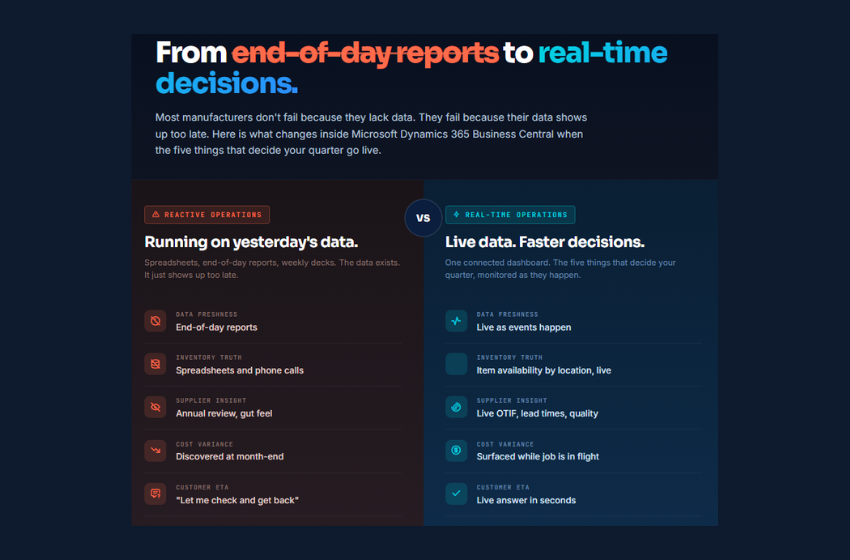
Production data is stale by the time it hits the screen. A work order slips at 11 a.m., the report shows it at 6 p.m., the plant manager sees it Tuesday morning, the customer finds out on shipping day. Each handover is a window where the problem could have been solved cheaply.
Inventory is a guess, not a fact. Stock counts lag a day behind reality. “Available to promise” turns into a phone call to the warehouse. Overstock builds because nobody trusts the system. Stockouts happen because the data caught up too late.
Supplier issues surface as customer complaints. Lead time drift, partial shipments, quality slips, your suppliers know about these long before you do. Without proper supply chain risk monitoring, the first sign of trouble is usually an angry customer.
Cost variance is found in the rear-view mirror. Standard cost looked fine. Actual cost killed the job. Finance closes the books, runs the variance report, and only then discovers the margin leak. The job is already done. The invoice is already out. The cash is already gone.
The pattern is the same in every case. The data exists. The data just shows up too late.
Swiss Re estimates that global supply chain disruptions now cost businesses $184 billion a year. McKinsey research shows a single major disruption can wipe out up to 42% of a year’s EBITDA for companies without visibility and agility. Those are not small numbers. They are the difference between a manufacturer that wins this decade and one that gets absorbed.
The good news, none of this requires you to abandon your ERP. If you are already running Business Central, or you are about to, real-time monitoring is a configuration question, not a platform question.
The Six Outcomes Real-Time Monitoring Actually Delivers
Real-time supply chain monitoring is not a feature. It is an operating model. When you commit to monitoring the right things live, six outcomes start showing up across the business. These are the outcomes a CEO or CFO can recognise on a P&L, not just on a dashboard.
1. You stop reacting, and start preventing
Production, inventory, supplier, machine, and cost data updates live. Decisions move out of the weekly meeting and into the moment the data changes. Gartner calls this exact shift the defining capability for the next two years.
2. You stop losing margin to late cost data
Cost variance is the silent killer of manufacturing margin. The longer the gap between standard and actual cost showing up, the harder it is to fix. Live cost variance means leaks surface while the job is still in flight, not at month-end.
3. You finally get an honest answer on suppliers
Most manufacturers have a vague sense that “supplier A is reliable and supplier B is a pain.” Real-time scorecards turn that gut feel into a defensible procurement conversation, and a foundation for the tier-two and tier-three visibility McKinsey identifies as the biggest blind spot in modern supply chains.
4. You unlock real OEE, not vanity OEE
Most manufacturers calculate OEE monthly, off a spreadsheet, with numbers that are already stale. Live OEE monitoring, powered by shop floor data flowing into Business Central and visualised in Power BI, turns OEE into an operating signal instead of a slide.
5. You compress the planning cycle
When demand, inventory, and production data update live, planning becomes a continuous loop instead of a weekly ritual. Each cycle you compress saves cash, frees capacity, and improves on-time delivery.
6. Every leader sees the same version of the truth
CFOs want margin and cash. COOs want throughput and on-time. CEOs want the headline and the early warnings. Role-based manufacturing dashboards built on the same Business Central data eliminate the “is this number right” debate, and put leadership straight into “what are we going to do about it.
The 5 Things Every Manufacturer Must Monitor in Real-Time
The five categories below are universal. Whether you run discrete, process, food and beverage, industrial equipment, CPG, or contract manufacturing, these cover the majority of margin, delivery, and quality risk in your supply chain.
Skip any of them, and the blind spot bites you within the quarter.
Production Order Status and Work-in-Progress
The boardroom question: Will we ship on time?
A CEO does not want a weekly production report. They want to know, before the customer does, that next Tuesday’s shipment is at risk.
Business Central already tracks production progress natively. The question is whether your team is seeing it live, or pulling it out of a spreadsheet on Monday morning. Live production monitoring means status, work-in-progress, capacity load, and emerging bottlenecks update as they happen, not as the next report cycle runs. Microsoft’s own production order documentation covers the operational engine, but the difference between “configured” and “monitored in real-time” is in how you surface the signal to the people who can act on it.
Inventory and Raw Material Availability
The boardroom question: Where is our cash, and what is at risk?
Inventory is cash sitting on a shelf. Stockouts halt the line. Overstock kills working capital. Both happen when the inventory number you are looking at is older than the operation it represents.
Real-time inventory visibility inside Business Central means item levels by location, raw material against reorder points, and finished-goods position update live. Add Power BI on top and the same data becomes a connected manufacturing dashboard across multiple sites. The CFO finally sees inventory the way they see cash, as a managed asset, not a guess.
Supplier Performance and Lead Times
The boardroom question: Which suppliers are quietly hurting us?
Suppliers do not tell you when they are slipping. Their data does, if you are watching.
Live vendor scorecards inside Business Central, covering on-time-in-full delivery, lead time drift, quality rejections, and non-conformance, turn supplier reviews from an annual ritual into an ongoing performance practice. For manufacturers ready to extend further, Microsoft’s supply risk assessment workspace pushes visibility into tier-two and tier-three risk, which McKinsey identifies as the single biggest gap in modern manufacturing.
Machine Uptime and OEE
The boardroom question: Are we getting full value from our assets?
Unplanned downtime quietly destroys EBITDA. A plant manager who sees OEE drift the day it starts will recover margin a finance team running off a month-end report never will.
Live OEE monitoring pairs Business Central machine centers and capacity data with Azure IoT signals from the shop floor and Power BI for visualisation. This is the layer where machines, sensors, and the ERP finally talk to each other, and where IoT production monitoring stops being a slide-deck idea and starts being a daily habit.
Cost Variance Against Standards
The boardroom question: Are we actually making money on this job?
This is the metric that most directly answers a CEO’s hardest question. Without live cost variance, the honest answer is, “we will know in three weeks.”
Real-time variance monitoring inside Business Central means material, labor, and overhead variances surface as the job is running, not after it closes. Margin per job, per product line, per customer becomes a number leadership can trust, in time to act on it.
Quick reference: the 5 things, side by side
| Thing to monitor | Primary owner | Boardroom question it answers |
| Production order status & WIP | COO, Plant Manager | Will we ship on time? |
| Inventory & material availability | CFO, COO | Where is our cash, and what is at risk? |
| Supplier performance & lead times | CPO, CFO | Which suppliers are quietly hurting us? |
| Machine uptime & OEE | COO, Plant Manager | Are we getting full value from our assets? |
| Cost variance against standards | CFO, Controller | Are we actually making money on this job? |
If your current setup cannot give you a live answer to any of those five boardroom questions, that is the gap real-time supply chain monitoring is built to close.
How This Plays Out Across Manufacturing Types
The five things to monitor are universal. How they show up on your shop floor depends on what you make and how you make it.
Discrete manufacturers live and die by committed ship dates against multi-level BOMs and complex routings. Real-time visibility means a plant manager sees bottlenecks the moment they form, and a sales rep can give a customer an accurate ship date without making a phone call.
Process manufacturers depend on batch yields and formula variances. Live monitoring ties quality, lot traceability, and ingredient availability into the same view that drives production decisions, so a batch trending out of spec is flagged in real time, not in next shift’s lab report.
Food and beverage manufacturers carry compliance and recall risk. Live lot tracking, expiry monitoring, and supplier compliance data are how you keep the audit clean and the brand intact.
Industrial and heavy equipment manufacturers are dominated by long-lead-time components and outsourced sub-assemblies. One delayed casting can push a high-value build out by a month. Real-time supplier and contract-manufacturer monitoring is what stops those surprises from reaching the customer.
CPG manufacturers face seasonal demand, promotion spikes, and retailer commitments that are unforgiving. Connecting production, warehouse, and outbound logistics into one live view is the difference between a successful promotion and an out-of-stock disaster on retailer shelves.
Contract and made-to-order manufacturers field constant “where is my job?” questions. Real-time job-level status gives sales, customer service, and the customer themselves an accurate answer in seconds, instead of a callback in hours.
The Microsoft Stack Behind Real-Time Supply Chain Visibility
Real-time monitoring is not one product doing one job. It is a connected stack. One of the strongest arguments for staying inside the Microsoft ecosystem is that these components already work together, no separate visibility platform required.
| Layer | Microsoft component | What it powers |
| ERP core | Dynamics 365 Business Central | Production, inventory, purchasing, warehouse, supply chain planning |
| Visualisation | Microsoft Power BI | Role-based manufacturing dashboards and supply chain KPIs |
| Unified data | Microsoft Fabric | One data foundation across ERP, shop floor, and external systems |
| Automation & apps | Power Platform | Custom workflows, mobile apps, alerts on exceptions |
| AI assistance | Microsoft Copilot | Supplier communication, exception handling, insight generation |
| Shop floor data | Azure IoT | Live machine signals for OEE and predictive maintenance |
For most SMB and mid-market manufacturers, this stack is more than enough. For larger or multi-entity operations, Dynamics 365 Supply Chain Management extends the capability set further.
How to Get Real-Time Monitoring Live, Without a 12-Month Project
The biggest misconception about real-time supply chain visibility is that it requires a multi-year transformation. It does not. A focused engagement gets most mid-market manufacturers to live dashboards inside a single quarter.
Phase 1: Visibility audit. Map what you monitor today, what you wish you could monitor, and where decisions are being made on stale data. The output is a prioritised list of blind spots.
Phase 2: Configure Business Central for the five things. Production, inventory, suppliers, OEE, and cost variance. This is where a partner that understands manufacturing earns their keep, because the difference between “configured” and “configured to surface the right signals” is everything.
Phase 3: Connect the data sources outside Business Central. Shop floor systems, IoT sensors, supplier portals, EDI feeds. One set of numbers, not five overlapping ones.
Phase 4: Build role-based dashboards. A CEO view, a CFO view, a COO view, a plant manager view. Same data, different lens. The operating rhythm of the business starts to change within weeks of these going live.
For manufacturers still planning the rollout, real-time monitoring should be designed into the implementation, not added later. A structured implementation methodology is the difference between a system that goes live and a system that is actually used.
For manufacturers already on Business Central, the dashboards and integrations are an overlay. You do not start over.
For manufacturers still on legacy NAV, GP, or AX, real-time monitoring is the strongest single argument for moving to Business Central sooner rather than later.
The Bottom Line for the Boardroom
Real-time supply chain monitoring is not a software feature. It is a decision about how your business runs.
You can keep running the operation on end-of-day reports, weekly decks, and the institutional memory of your best people. That model used to work. With the disruption profile manufacturers face today, it is quietly costing you margin, customers, and competitive ground every quarter you stay with it.
Or you can decide that the five things every manufacturer needs to monitor in real-time, production, inventory, suppliers, machine uptime, and cost, are going to be live, on one connected dashboard, in the hands of the people who can act on them. That decision is what separates a reactive plant from a proactive one.
Business Central for manufacturing gives you the foundation. Power BI gives you the lens. Azure IoT gives you the shop floor signal. The configuration choice is what turns it into an operating advantage.
If you would like to walk through what real-time supply chain monitoring would look like for your specific operation, our team is happy to do that with you, no obligation. Contact us today to schedule a working session, or download the Real-Time Supply Chain Monitoring Playbook for Manufacturers to share with your leadership team before the conversation.
Frequently Asked Questions
What does real-time supply chain monitoring actually mean inside Business Central?
It means production order status, inventory levels, supplier performance, machine uptime, and cost variance update live as events happen on the shop floor, in the warehouse, and across your supplier network, not at end of day. With the right configuration, Business Central becomes a real-time supply chain visibility software your whole operation runs on, paired with Power BI for the role-based dashboards.
Is Business Central enough on its own, or do I need additional tools?
Business Central covers the core, production, inventory, purchasing, warehouse, and supply chain planning. For full real-time visibility, it pairs with Power BI for dashboards, Microsoft Fabric for unified data, and Azure IoT for shop floor signals. You do not need bolt-on third-party visibility platforms. The Microsoft stack already does the job.
What are the five critical things every manufacturer should monitor?
Production order status and work-in-progress. Inventory and raw material availability. Supplier performance and lead times. Machine uptime and OEE. Cost variance against standards. Get these five right in real-time and you cover the majority of margin, delivery, and quality risk in a manufacturing supply chain.
How is real-time monitoring different from running reports out of my ERP?
Reports tell you what already happened. Real-time monitoring tells you what is happening now, so you can act in time to change the outcome. The shift from reports to live dashboards is the single biggest operating change available to manufacturers right now, and it does not require replacing the ERP, only configuring it differently.
Is Business Central the right fit for a mid-market manufacturer, or do we need Dynamics 365 Finance and Supply Chain Management?
For most SMB and mid-market manufacturers, Business Central is the right home for real-time monitoring, without the cost and complexity of an enterprise platform. The call depends on operational complexity, not headcount. For multi-entity, multi-country, or very high transaction volumes, Dynamics 365 Supply Chain Management is worth a serious look.
How long does it take to get real-time dashboards live?
If Business Central is already in place, role-based real-time dashboards can be live in weeks, not months. If Business Central is being implemented from scratch, real-time monitoring is designed into the rollout from day one, not added as a phase-two project.
What are the most important manufacturing KPIs to monitor?
On-time delivery, OEE, production order cycle time, inventory turns, supplier on-time-in-full, scrap and rework rate, and cost variance against standards. These are the supply chain KPIs and manufacturing KPIs that move both operational and financial outcomes.