Imagine your organization running critical workflows on autopilot, invoices reconciling themselves, supply chains adjusting to disruptions in real time. This is no longer a futurist’s dream, AI agents are making it possible today. According to a recent survey, 81% of business leaders expect AI agents to be moderately or extensively integrated into their company’s strategy. Yet enthusiasm alone isn’t enough, an MIT study found that 95% of enterprise AI projects fail to deliver a measurable return. The solution lies in embracing AI-driven business automation in the form of autonomous ERP agents that combine artificial intelligence with business process automation to truly transform your enterprise.
By understanding what these agents are and how they enhance finance, supply chain, and IT operations, your organization can unlock new levels of efficiency, agility, and ROI.
What Are Autonomous AI Agents in ERP and Why Are They Important?
Autonomous AI agents are intelligent software entities that act as “digital colleagues” within your Enterprise Resource Planning system. Unlike traditional macros or rigid scripts, these agents learn and adapt over time. They can operate independently or as a team of specialized agents, making decisions and executing tasks in real time. In practice, an autonomous ERP agent might monitor thousands of signals across your data, from internal transactions to external market indicators and then adjust processes accordingly. This level of context-aware decision-making goes far beyond basic workflow automation. Think of it as turning your ERP from a static system of record into an intelligent partner that can reason, predict, and act.
Importance of AI Agents in ERP
In today’s dynamic business environment, static rules break easily. Enterprise AI agents bring resilience. They can, for example, detect anomalies or bottlenecks and proactively resolve them without waiting for human intervention. Multiple agents can even collaborate across different domains (procurement, inventory, finance) by communicating through standard protocols like Microsoft’s Model Context Protocol, sharing context and coordinating actions. This coordination breaks down silos and accelerates business process automation across departments. The result is an ERP that continuously optimizes itself, predicting issues before they arise and seizing opportunities faster than any manual process could. In short, autonomous AI agents make your ERP adaptive and intelligent, which is crucial for staying competitive.
AI Agents in Finance: Improving Workflows and ROI
For CFOs and finance leaders, the promise of AI agents in finance is transformative. Day-to-day financial operations from accounts payable and receivables to expense management and financial close are riddled with repetitive tasks and data entry that consume valuable time. Autonomous agents are changing this paradigm by handling these workflows end-to-end. Let’s look at how AI agents improve finance workflows in practice.
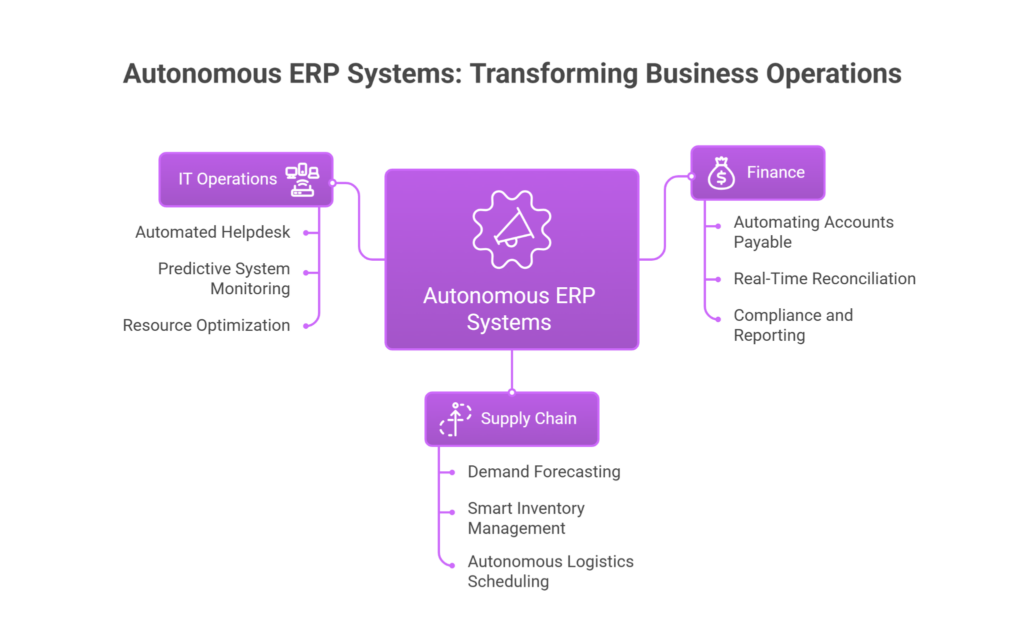
Automating Accounts Payable
Instead of clerks manually entering invoice data and matching purchase orders, an AI agent can scan incoming invoices, extract relevant details, cross-validate them against POs and receipts, and flag any discrepancies for review. The agent learns from exceptions; over time it gets better at matching and coding invoices. This not only speeds up processing but also cuts errors dramatically.
Real-Time Reconciliation
Much of the financial close and reconciliation process can be automated. For instance, Microsoft Dynamics 365 offers a Financial Reconciliation Agent that autonomously matches ledger entries, flags discrepancies, and even suggests adjustments. Such AI-powered ERP agents work 24/7 to keep your books current, freeing finance teams to focus on analysis and strategy.
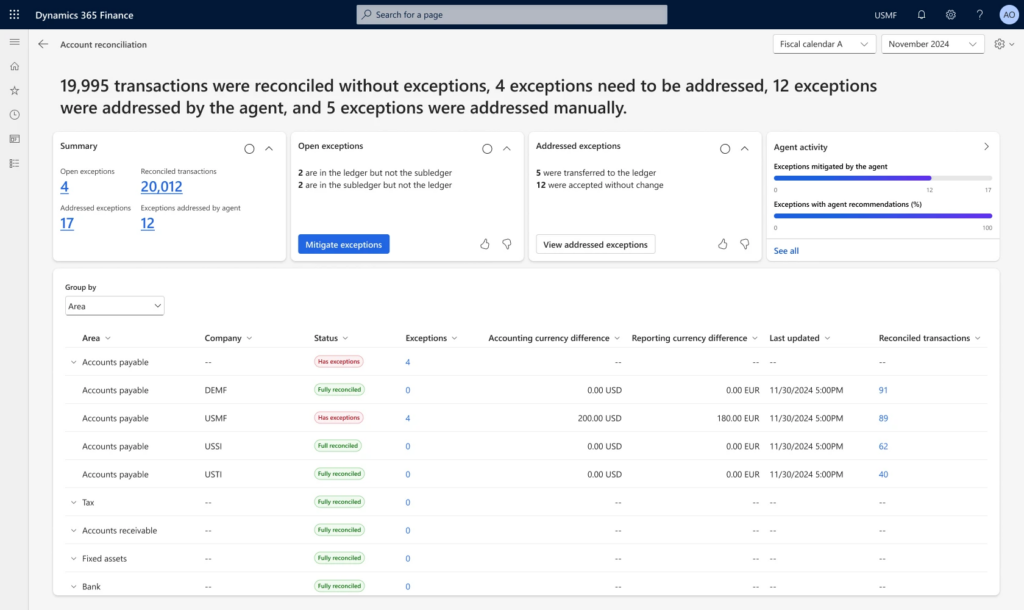
Account Reconciliation Agent (Source: Microsoft)
Compliance and Reporting
Finance involves strict compliance (tax rules, audit trails, etc.). AI agents can monitor transactions for compliance in real time, flagging anomalies (like potential fraud or policy violations) instantly. They can also compile reports for regulators or management faster by pulling data from multiple sources automatically. This intelligent monitoring reduces risk and ensures more accurate reporting.
The AI impact on ROI in finance is significant. By accelerating workflows and eliminating mistakes, companies save on labor costs and avoid costly errors or penalties. Moreover, finance staff are freed to focus on high-value activities like financial planning and analysis. This shift from manual processing to enterprise AI-driven insights means better decision-making and ultimately a healthier bottom line. In a domain where accuracy is paramount, the benefits of autonomous ERP systems in finance include faster closes, better cash flow, and strengthened compliance, all contributing to a clear ROI.
AI Agents in Supply Chain: Driving Resilience and Agility
Global supply chains are under constant pressure from disruptions, be it geopolitical events, natural disasters, or sudden demand shifts. AI agents in supply chain management offer a way to navigate this volatility with unprecedented agility. Traditional planning tools react to changes slowly and often require human intervention when conditions deviate from the norm. In contrast, an autonomous agent can digest real-time data streams and make on-the-fly adjustments to keep your operations running smoothly.
Demand forecasting for seasonal peaks
AI agents analyze historical sales data, market trends, and external factors like holidays or events to predict demand surges with remarkable accuracy. By anticipating seasonal peaks weeks or months in advance, these agents help businesses prepare inventory levels and staffing requirements, ensuring they can meet customer demand without overproduction or waste.
Smart inventory management
Autonomous agents continuously monitor stock levels across multiple locations, analyzing real-time sales velocity, supplier lead times, and storage costs. They automatically trigger reorders when inventory reaches optimal thresholds, redistribute stock between warehouses to balance supply and demand, and identify slow-moving items for clearance, all while minimizing carrying costs and preventing stockouts.
Autonomous logistics scheduling
AI agents optimize delivery routes, carrier selection, and shipment timing by processing real-time data on traffic conditions, fuel costs, and carrier availability. They can dynamically reschedule pickups and deliveries to avoid delays, consolidate shipments for cost efficiency, and even negotiate rates with carriers based on current market conditions – ensuring goods move through the supply chain at optimal speed and cost.
Real-Time Coordination Across the Supply Chain
To illustrate the role of AI agents in supply chain optimization, imagine these intelligent assistants working in tandem. A procurement agent continuously monitors suppliers and market conditions, if a key supplier is likely to delay delivery, the agent proactively finds alternatives or adjusts orders. Meanwhile, a logistics agent watches transportation networks and can reroute shipments to avoid disruptions such as port closures or extreme weather. Together, these agents keep the supply chain running smoothly. In fact, Microsoft’s Supplier Communications Agent already demonstrates this agility by automatically handling routine supplier emails and slashing rush-order fees while preventing costly delays.
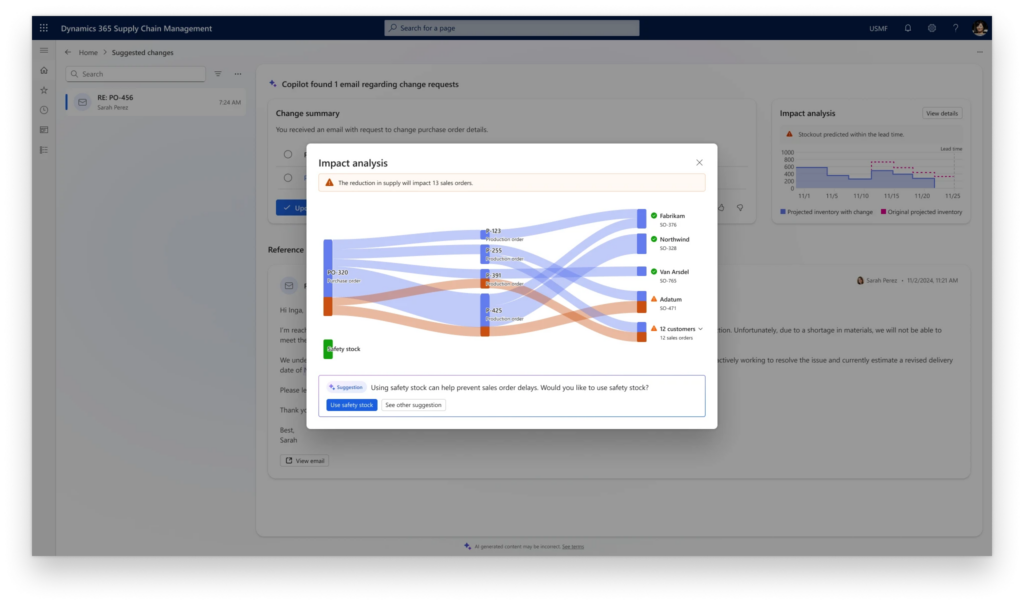
Supplier Communications Agent (Source: Microsoft)
Enhanced Efficiency and Strategic Focus
AI agents can balance stock levels by analyzing real-time sales data and lead times, then trigger reorders just in time. This dynamic optimization keeps inventory carrying costs low while avoiding shortages. Importantly, these agents operate with minimal human intervention, acting as always-on problem solvers that keep your supply chain on track. Human managers, in turn, can focus on strategic planning and supplier relationships rather than firefighting daily issues. In an era where supply chain resilience is a competitive advantage, autonomous agents provide the speed and foresight needed to adapt to whatever comes next.
AI Agents in IT Operations
Beyond finance and supply chain, AI agents in IT are helping CIOs optimize technology management and reduce costs. IT departments often juggle routine tasks like system monitoring, user support, data backups, and patch management, chores that are essential but time-consuming. Here, autonomous agents act as tireless assistants, handling everything from helpdesk tickets to infrastructure monitoring, transforming IT operations from reactive to proactive.
Cost Reduction and Efficiency
An IT support agent can handle common helpdesk tickets by automatically diagnosing issues (resetting passwords, provisioning accounts, resolving known errors) without human help. Similarly, an AI operations agent might watch infrastructure logs and performance metrics to predict outages or capacity bottlenecks, then either alert the team or trigger preventive actions. This proactive approach to IT management means fewer incidents and faster resolutions, directly linking AI agents and IT cost reduction through less downtime and more efficient use of staff.
Automated helpdesk
AI agents handle tier-1 support requests instantly, resolving common issues like password resets, software installations, and access permissions without human intervention. They can diagnose problems by analyzing error logs, guide users through troubleshooting steps via chat, and escalate complex issues to human technicians only when necessary, reducing ticket resolution time from hours to minutes while freeing IT staff for higher-value work.
Predictive system monitoring
Autonomous agents continuously analyze system performance metrics, network traffic, and application logs to detect anomalies before they become critical failures. They can predict when servers will reach capacity, identify security vulnerabilities in real-time, and automatically apply patches during off-peak hours, transforming IT from reactive firefighting to proactive optimization and preventing costly downtime.
Resource optimization
AI agents track cloud usage, software licenses, and infrastructure utilization to identify waste and optimization opportunities. They can automatically scale resources up or down based on demand, flag unused licenses for cancellation, recommend server consolidation, and even negotiate better rates with vendors by analyzing usage patterns delivering measurable cost savings while ensuring optimal performance.
Proactive IT Management
The AI impact on ROI in IT also comes from optimizing resource allocation. By automating routine maintenance and support, organizations can operate with leaner IT teams or redirect their experts to more innovative projects. Plus, intelligent agents help avoid outages by monitoring systems continuously (something human admins cannot do 24/7). Fewer failures and faster fixes mean higher business uptime and less revenue loss, a direct boost to ROI.
Key Benefits of Autonomous ERP Systems
Adopting autonomous AI agents in your ERP yields wide-ranging benefits for business process automation and performance. Here are some of the key advantages that C-level executives should consider:
- Efficiency and Productivity: AI agents execute tasks faster and with fewer errors than manual processing. Processes that used to take weeks can be done in hours. This boost in efficiency means your teams spend less time on repetitive work and more on strategic initiatives.
- Better Decision Making: Agents analyze data in real time and help surface insights (e.g. spotting anomalies or trends) that humans might miss. By ensuring high-quality data and instant analysis, they enable more informed and timely decisions. For example, an autonomous ERP can react to market changes or internal variances immediately, giving your organization a decision-making edge.
- Cost Savings and ROI Improvement: By reducing labor-intensive work and minimizing errors or disruptions, AI agents directly contribute to cost reduction. Fewer manual hours and mistakes translate to operational savings. Moreover, preventing issues (like supply chain delays or compliance fines) protects revenue. These factors combined lead to a higher return on investment over time, as the AI agents and IT cost reduction benefits accumulate.
By leveraging these benefits of autonomous ERP systems, companies transform their ERP from a static system into a living, intelligent partner in the business. The result is an organization that operates more smoothly, responds faster, and achieves more with the same resources.
Conclusion: Preparing Your Organization for Autonomous ERP
AI agents are quickly becoming essential in finance, supply chain, and IT, driving efficiency, cost savings, and agility across operations. Early adopters are already reaping the rewards, and laggards risk falling behind
Fortunately, you don’t have to navigate this journey alone. Folio3, a certified Microsoft Dynamics 365 implementation partner, specializes in helping companies integrate AI agents into their ERP landscape.
By partnering with experts like Folio3 to implement these capabilities in Dynamics 365, you can ensure measurable ROI and transform your ERP into the intelligent backbone of your enterprise. Don’t miss this opportunity, talk to our expert now and embrace AI agents in ERP before your competitors do.
FAQs
Can AI agents actually do invoice processing in ERP?
Yes, as seen in real-world discussions, AI agents can parse invoices, validate against POs, and send data into your ERP. In a Dynamics 365 setup, they can learn from exceptions and improve over time.
How do agents help with supply chain disruptions?
Autonomous agents analyze live signals (supplier delays, inventory levels) and make decisions like reordering or rerouting. They bring real-time adaptability to your ERP’s supply chain module.
Do AI agents reduce IT support workload?
Yes, agents can handle routine helpdesk tasks (password resets, common errors) and also monitor system health to predict issues. Over time, they free IT staff for higher-value work.
Is agentic ERP mature or just hype now?
Agentic ERP is becoming very real. For example, Microsoft has preview agents in Dynamics 365 that already automate tasks like account reconciliation.
Can agents learn and improve in autonomous ERP?
Absolutely, agents improve by processing exceptions, receiving feedback, and collaborating in multi-agent workflows. Over time, they become more autonomous and efficient.
What are the risks of deploying AI agents in ERP?
Common concerns include over-complexity, unclear ROI, or agents mis-handling unusual cases. It’s wise to start small, run pilot workflows, and use governed platforms (like Dynamics 365) to control risk.